2026 Toyota Grand Highlander vs Honda Pilot: Three-Row Showdown
Two of the roomiest mainstream three-row SUVs, compared on price, power, hybrid efficiency, cargo, and towing. Which one earns the family driveway in 2026?
Contender A
2026 Toyota Grand Highlander
Contender B
2026 Honda Pilot
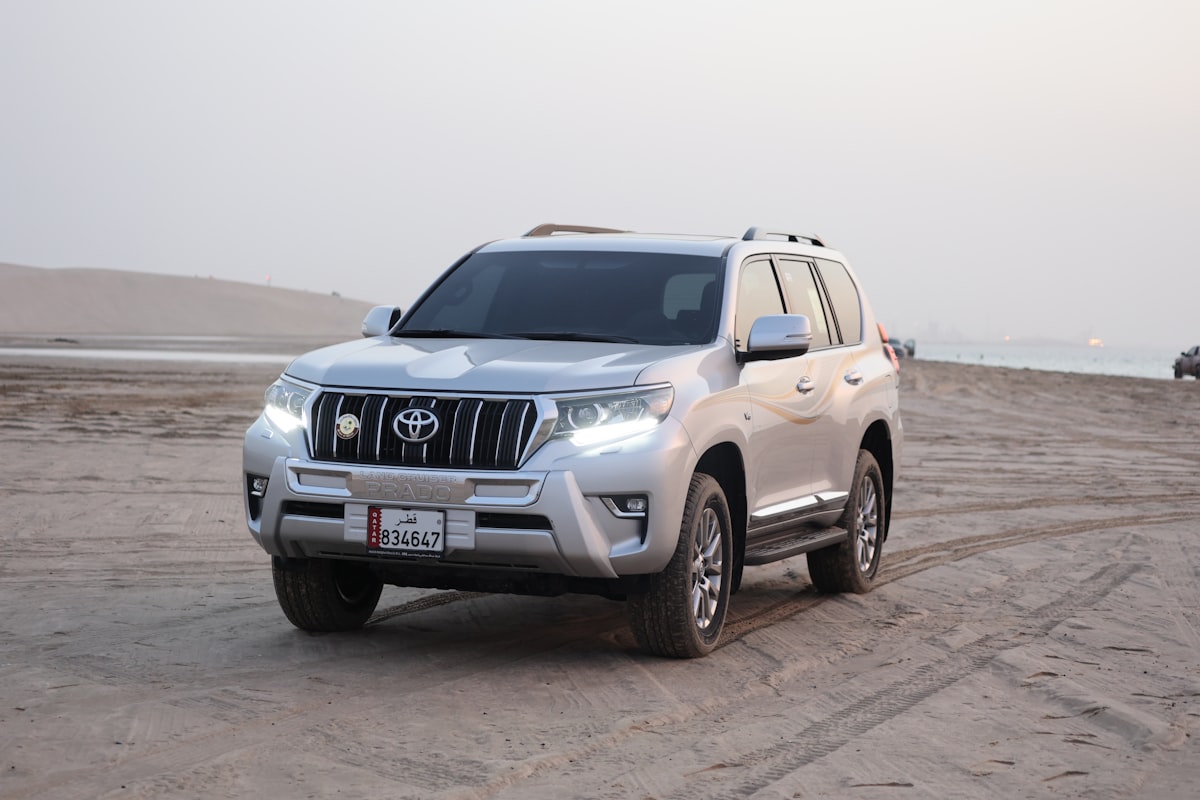
If you need three real rows of seats and you've crossed a minivan off the list, these are the two I end up recommending more than any others. The Toyota Grand Highlander exists for one reason — to fix the regular Highlander's punishing third row — and it nails it. The Honda Pilot is the segment's other big, sensible, do-everything pick. They overlap so heavily on price and mission that I tell people the real decision is about powertrain philosophy: do you want options, or do you want simplicity?
At a glance
| Spec | Grand Highlander | Pilot |
|---|---|---|
| Base MSRP | $41,200 | $41,000 |
| Engine (base) | 2.4L turbo I4, 265 hp | 3.5L V6, 285 hp |
| Top powertrain | Hybrid MAX, 362 hp | 3.5L V6, 285 hp |
| Transmission | 8-speed auto / eCVT | 10-speed auto |
| EPA combined (base) | 24 mpg | 22 mpg |
| Cargo behind 3rd row | 20.6 cu-ft | 18.6 cu-ft |
| Max cargo | 97.5 cu-ft | 87.0 cu-ft |
| Max towing | 5,000 lb | 5,000 lb |
| Seating | 7 or 8 | 7 or 8 |
Both figures include destination. The headline difference, to me, is that Toyota hands you three powertrains — two of them hybrids — while Honda hands you one well-sorted V6 and keeps the menu short.
Powertrain
The Pilot's 3.5-liter V6 makes 285 horsepower and 262 lb-ft through a 10-speed automatic. It's naturally aspirated, so the power is linear and predictable — no turbo lag, no hybrid handoff to think about. At a steady cruise it's the more refined-feeling drivetrain, and frankly it sounds better doing it.
Toyota's lineup is the more interesting one. The base 2.4-liter turbo four (265 hp) is perfectly fine. The standard hybrid (245 hp) is the efficiency play. But the one I'd actually buy is the Hybrid MAX: a turbo-hybrid making 362 horsepower and 400 lb-ft, which makes a loaded Grand Highlander genuinely quick — 0–60 in about 6.3 seconds, well clear of the Pilot's 7.0.
Verdict on powertrain: If you value smoothness and simplicity, the Pilot's V6 is lovely. If you want either real efficiency or real speed, Toyota's range covers both ends and the Pilot has no reply.
Fuel economy
This is the Grand Highlander's clearest structural edge, simply because the Pilot has no hybrid at all.
| Spec | Grand Highlander | Pilot |
|---|---|---|
| Base engine combined | 24 mpg | 22 mpg |
| Hybrid combined | 36 mpg | — |
| Hybrid MAX combined | 27 mpg | — |
Run the numbers the way I do: a family covering 15,000 miles a year in the standard Grand Highlander Hybrid versus a V6 Pilot will spend roughly $900 to class="relative z-10",100 less per year on fuel at today's pump prices. Over a typical six-year hold, that's real money — enough to cover the hybrid's modest premium several times over.
Cargo and third row
People buy these for space, and both deliver. But the Grand Highlander's whole reason for existing is that third row, and it's the more usable of the two for actual adults — more legroom, a taller roofline, easier entry. The numbers back up what I feel climbing in:
| Spec | Grand Highlander | Pilot |
|---|---|---|
| 3rd-row legroom | 33.5 in | 32.5 in |
| Behind 3rd row | 20.6 cu-ft | 18.6 cu-ft |
| Behind 2nd row | 57.9 cu-ft | 48.5 cu-ft |
| Max cargo | 97.5 cu-ft | 87.0 cu-ft |
The Grand Highlander wins every cargo measure, and the nearly 10-cubic-foot gap behind the second row is the kind of thing you notice on a Costco run. The Pilot's clever counter is a removable second-row middle seat that stows in the cargo floor — so you can flip between 8-passenger and captain's-chair layouts without leaving a seat in the garage. I genuinely like that trick.
Interior, tech, and off-road
Both run big standard touchscreens (Toyota's 12.3-inch Audio Multimedia, Honda's Google-built system), wireless CarPlay and Android Auto, and full standard driver-assist (Toyota Safety Sense 3.0, Honda Sensing). Material quality is close enough to call a wash — the Pilot feels a touch more solid, the Grand Highlander a touch more modern.
Where they actually split is dirt. The Pilot TrailSport is a legitimately more capable trim: a 1-inch lift, a real torque-vectoring AWD system, all-terrain tires, steel skid plates. The Grand Highlander offers AWD but no true off-road variant. If your weekends involve trailheads and fire roads, I'd weight that heavily.
Verdict on interior and capability: Dead even on daily tech and comfort. The Pilot TrailSport is the pick the moment you leave pavement.
Reliability and resale
Both brands live at the top of the mainstream reliability rankings, and both of these drivetrains are conservative, proven hardware — Toyota's hybrid system especially, with a decade-plus track record and effectively zero systemic failures. My five-year resale read favors Toyota slightly:
- Grand Highlander: 62% of MSRP
- Pilot: 58% of MSRP
That's a class="relative z-10",500-to-$2,200 swing at trade-in time on comparably equipped trucks, driven mostly by hybrid demand and Toyota's brand strength here.
The verdict
Buy the Grand Highlander if you want the bigger third row and cargo hold, you care about fuel economy, or you want the genuine speed of the Hybrid MAX. It's the more space-efficient, more economical choice, and it holds value better. For most families cross-shopping these two, it's the smarter long-term buy — and it's the one I'd put in my own driveway.
Buy the Pilot if you prefer the refinement and simplicity of a naturally aspirated V6, you want the flexibility of that removable middle seat, or you actually go off-road and the TrailSport appeals.
Neither is a mistake. The Grand Highlander is my head pick on numbers; the Pilot is the pick for buyers who want a V6 done right. For current incentives on both, see my family SUV deals for June 2026, and for the smaller-sibling matchup, Honda Pilot vs Toyota Highlander.
From the Buying Guide
OTD price calculator
Get the real total — tax, title, registration, and doc fees — for any car in any US state.
Read more →Financing playbook
Pre-approval, what APR you really qualify for, and the four F&I traps to refuse.
Read more →Car-buying glossary
APR, money factor, residual, MSDs — plain-English definitions for every term on a dealer paperwork.
Read more →Related articles
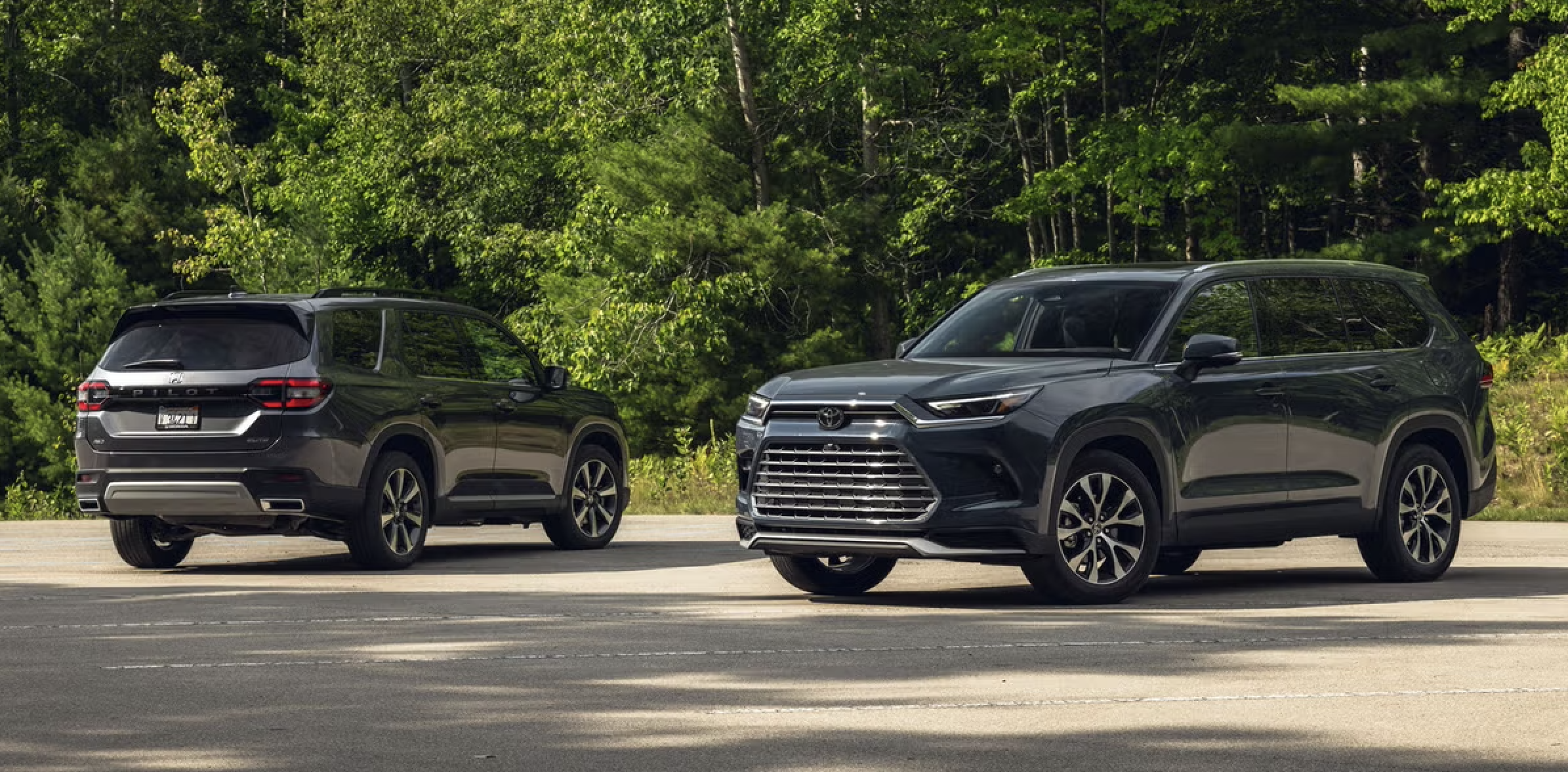
2026 Honda Pilot vs Toyota Highlander
Three rows, eight seats, family priorities: how the 2026 Honda Pilot and Toyota Highlander stack up on space, towing, efficiency, and price.
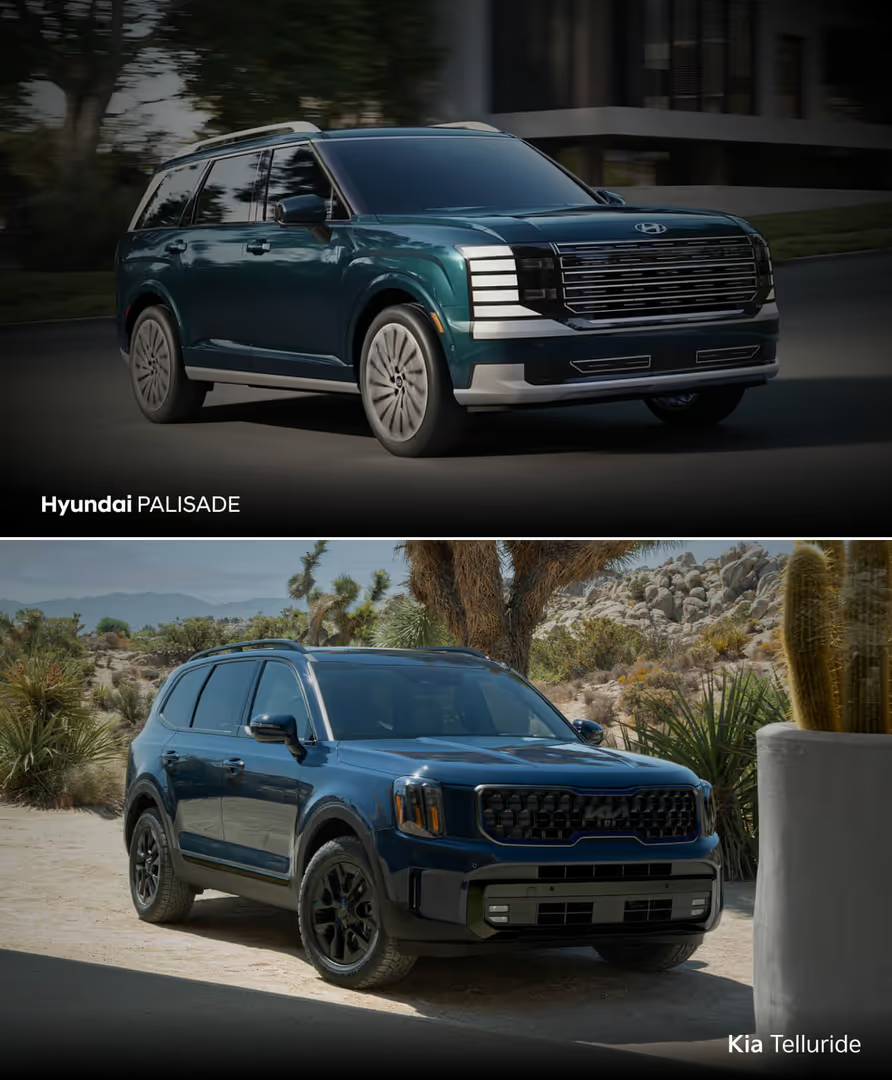
2026 Kia Telluride vs Hyundai Palisade: Three-Row SUV
Same platform, different personalities. Telluride and Palisade compared on price, ride, third row, tech, and resale for 2026 buyers.

Best Family SUV Deals — June 2026
APR, cash, and lease programs on three-row family SUVs for June 2026. Telluride, Pilot, Grand Highlander, Explorer, and more, valid through June 30.